How might we design a conversational agent that provokes behavior change to reduce excessive mobile phone use?
Summary
As part of my Master’s thesis, I designed and conducted a 7-week behavioral study with 33 participants who wanted to reduce their screen time.
I created Nola, a conversational agent that expressed disappointment and anger when users exceeded their intended phone usage, to explore how emotionally expressive feedback could influence digital habits.
Study Overview
This study aimed to explore the influence of different voice feedback methods on mobile phone usage time (=screen time).
In the study, participants set a daily screen time goal and reported their actual usage to a Telegram bot called Nola. If they exceeded their goal, Nola responded with a voice message in one of three tones: angry, disappointed, or neutral. While all types of feedback reduced screen time during the intervention, the tone itself had little impact.

Problem
Smartphone overuse is a growing problem among Gen Z that demands attention.
It often shows addiction-like symptoms such as compulsive use and withdrawal, and can worsen existing mental health conditions like anxiety and depression. It can also harm relationships with family and friends, and reduce overall quality of life and emotional well-being.

Solution
I designed a conversational agent, Nola, that acts as an accountability partner to help users reduce their screen time.
Conversational agents are systems that simulate human interaction through text or voice. Most are designed to be polite and agreeable, often avoiding emotional expression. In real life, however, negative emotions can play an important role in guiding behavior. This led me to explore whether emotionally expressive feedback, such as anger or disappointment, could be more effective in helping users stay committed to reducing their screen time.

User Interaction
At the start of each week during the three-week intervention, users set a maximum daily screen time goal.
To ensure realistic goals and prevent users from gaming the system, their screen time data from the previous two weeks was used as a baseline. Users could not set a limit higher than their recent average usage.
User Interaction
Each day, users reported their screen time to the bot, and the Telegram bot sent audio message as a feedback.
If user spent the same amount of time or less than intended, the tone of the audio message was neutral for all groups. In case when user couldn't achieve the goal, In the experimental groups, the message expressed anger or disappointment, while in the control group it remained neutral.

Positive - Neutral (All Groups)
Negative - Angry
Negative - Disappointed
Negative - Neutral
Experiment Participants
33 university students participated in the experiment.
Participants were randomly assigned to three groups receiving angry, disappointed, or neutral feedback, with a balanced gender ratio across groups.

Data
Screen time was measured across three periods to compare behavior before, during, and after the intervention.
Pre-Intervention (PRE): 2 weeks before the experiment
Mid-Intervention (MID): 3 weeks during the experiment, when users interacted with the Telegram bot
Post-Intervention (POST): 2 weeks after the experiment ended

Analysis
Screen time measurements were analyzed using Linear Mixed Effects model.
A linear mixed-effects model was used because the data was collected from the same participants over time. This method accounts for individual differences while identifying overall trends, making it well-suited for repeated measurements.
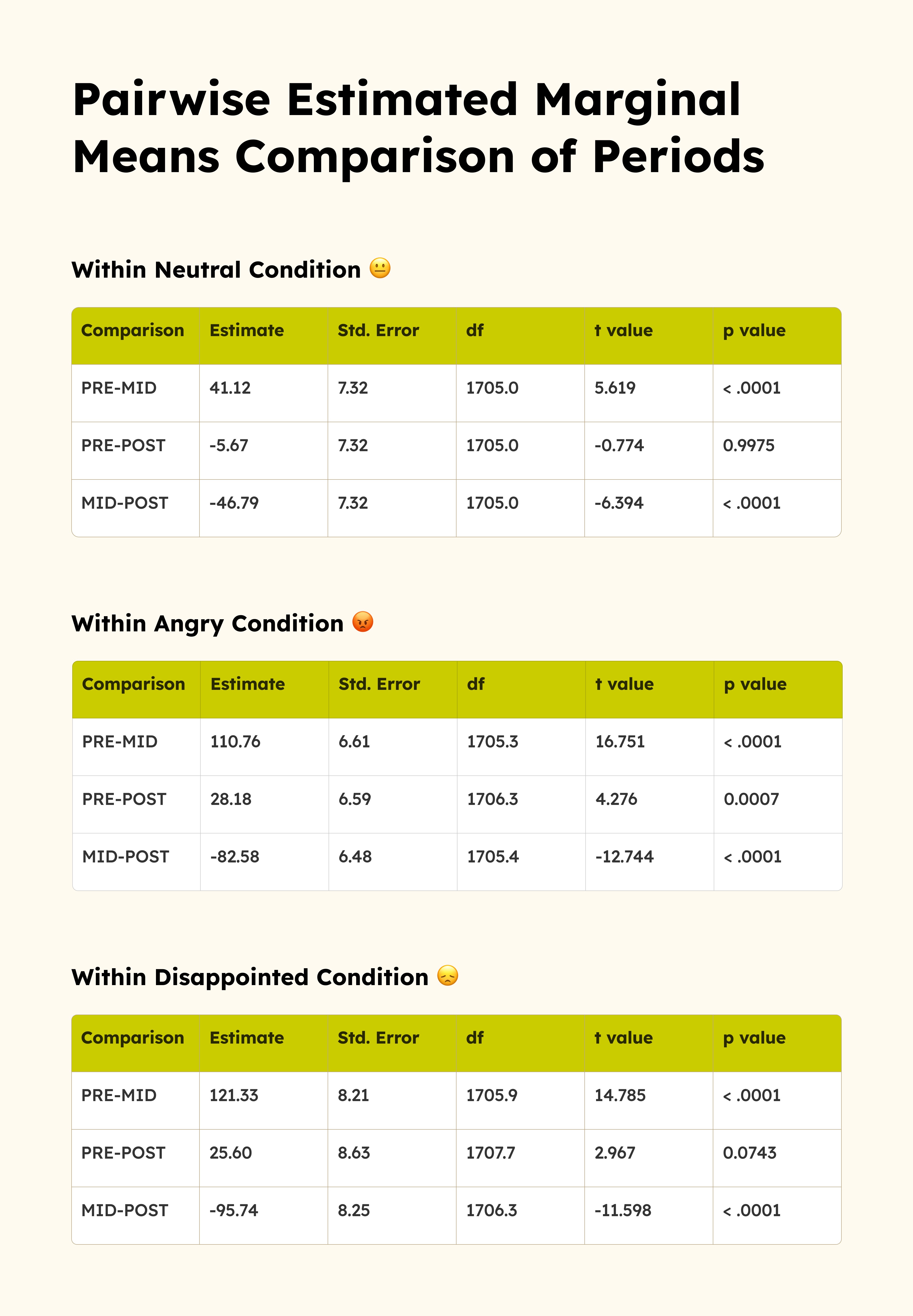
The model’s predictions show a decrease in screen time across all groups during the intervention period, followed by an increase after it ended, indicating that the effect was not sustained without ongoing feedback. Pairwise comparisons of the three periods (PRE, MID, POST) within each condition (Angry, Disappointed, Neutral), as well as between conditions, were used to determine whether these differences in screen time were statistically significant.

Results
All three types of feedback were effective in reducing screen time.
The emotional tone of the feedback (whether Neutral, Angry, or Disappointed) did not significantly impact its effectiveness; the presence of feedback alone was sufficient to reduce screen time.
After the interaction period, screen time increased for all conditions, indicating that the behavior change was not sustained without the ongoing presence of the conversational agent.
Screen time returned to pre-intervention levels in the Neutral and Disappointed groups once the interaction ended, while the Angry group showed a statistically significant reduction.

Implications for Designers