How might we help people with acne to feel better?

Summary
Skiná is a mobile application concept that aims to support people struggling with acne.
This project was created as a part of graduation requirement from Bachelor's degree. Each student was given a complete freedom in choosing a topic and further development of the project.
Background
Acne affects more than your skin.
Appearance is important for acceptance in society, and unfortunately, it does not fit into any of the standards of beauty. Very often, acne becomes a cause of insecurity and suffering for its owner.


Problem
Conventional acne treatment program does not take into account the mental state of patients.
The impact of acne is just getting to be acknowledged. In 2021, the National Institute for Health and Care Excellence published their acne treatment guideline, where it advises clinicians to consider referral to mental health services where appropriate.
🤔 The Challenge
How might we help people with acne to feel better?
Solution
Nice to meet you, I'm Skiná!
Skiná is a social platform that empowers people with acne to embrace self-acceptance through mindfulness, emotional support, and community. Powered by A.I. Skiná, the app provides personalized encouragement while connecting users with others who share similar experiences. Together, they can exchange stories, support one another, and navigate their skin journey in a safe, judgment-free environment.





Primary Research
How does it feel to have acne? Well, not good at all.
I began my research with a general question: “What is it like to have acne?”. I conducted an online research on 4 social media platforms (Instagram, Reddit, Youtube, Facebook) through reading documented experiences of people with acne. I reflected all of my findings in Empathy Map. My main takeaways about those posts are that they contain overwhelmingly negative experiences and most of them were made by women.

User Interviews
“When almost everyone around you has skin trouble it is not odd anymore - it becomes the new standard.”
I recruited 3 women in their early 20s for user interviews. I defined that my target users are women for two reasons: they suffer from acne more frequently as adults, and are more vulnerable to poor quality of life and low self-esteem due to acne. I was interested in their acne history: how they got acne, challenges they experienced, and what have they tried to attempt to solve their problem. Below are the main insights, organized into 3 themes.

Psychologist Interview
“Nobody comes to my office saying they want to accept themselves. People come in pain and hope that I could do something.”
Based on all the previous research, I created two personas. Persona #1 is a distressed "newbie" who just got acne and tries to figure out what's going on, while persona #2 had acne for a while and got used to it.

Defining Target Audience
Depending on the duration of having acne, there are different needs.
Based on all the previous research, I created two personas. Persona #1 is a distressed "newbie" who just got acne and tries to figure out what's going on, while persona #2 had acne for a while and got used to it.


Concept Development
Alleviating pain right now, achieving self-acceptance in the long-run.
At this point, I decided the following points about my concept:
There would be an A.I. agent to provide emotional help.
The app would help would help the users to achieve self acceptance by writing diaries.
It would be a social media so that people with acne could easily connect with others. For ease of access, I would like to design a mobile application.


Design
From idea to implementation.
In total, I had 3 design iterations. I created one paper and two high-fidelity prototypes. With each iteration, I refined the application concept as well as the design.

Feature 1
Having acne is emotionally challenging. Artificial Intelligence helps to get through hard times and achieve mental well- being.

Feature 2
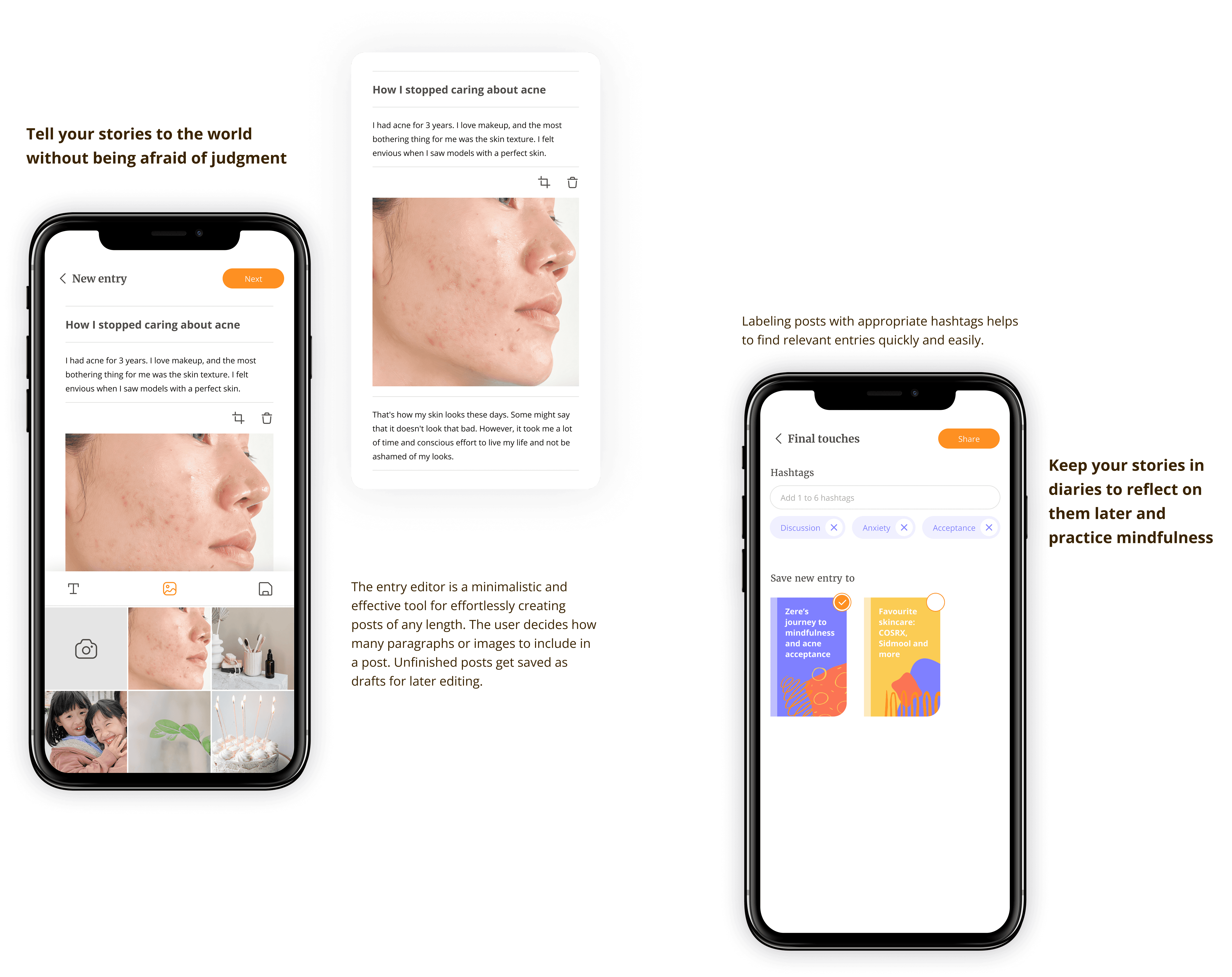
Each diary is beautiful and unique, like each person's skin. At Skiná, posts created by users are stored in diaries with a customizable design.

Feature 3
Acne adds its fair share of stress to life. Speak out on anything and release tension: from how acne affects you emotionally to the kind of treatment you are currently undergoing.
Feature 4
Discussion is the first step towards normalizing acne in society. The feed highlights exciting opinions and stories to read and digest.
