How might we bring fragmented educational workflows into one unified platform?
Summary
SmartestPrep Teachers is an internal platform that helps SmartestPrep, a university admissions preparation center, streamline its day-to-day educational and operational workflows.
Before SmartestPrep Teachers, the company relied on external tools and fragmented workflows to support its day-to-day operations.
As the sole designer, I led the product design from concept to implementation, creating all screens and interactions while working closely with users and engineers.
Design Schowcase




Background
SmartestPrep is an educational center that helps high school students prepare for university admissions.
📚 Academic Team
Responsible for creating educational materials on the platform and overseeing all learning formats, including online and offline classes, individual lessons, group sessions, and pair learning.
🎓 Admissions Team
Guides students through the entire international university admissions journey, from university selection to final enrollment.

Problem
Employees managed workflows through external tools such as Google Sheets, Notion, and Telegram, which were not designed to support the company’s operational needs.
Fragmented Client Information
There was no centralized database of active clients, forcing employees to search across multiple channels to find basic student information when handling requests or disputes.
Untracked Student Outcomes
The company lacked a system for tracking exam scores and university admissions results, causing valuable student success stories and marketing opportunities to be lost.
Limited Platform Management
Although students used an online learning platform, employees could not control access to materials or monitor student activity and learning progress effectively.
Untracked Installment Payments
Without a centralized way to track installment payments, the company struggled to monitor student balances and collect payments consistently.
Product Vision
Centralizing internal operations with SmartestPrep Teachers.
🎯 Shared Goals for the Academic and Admissions Teams
Maintain a single source of truth for client information.
Monitor the performance of teachers, admissions mentors, and student coordinators.
📚 Academic Team Goals
Manage class operations.
Monitor student academic performance.
🎓 Admissions Team Goals
Track application progress for each student.
Record admission outcomes.
Role
As the sole designer on the project, I created all screens and interactions.
My responsibilities included conducting research, designing user flows for development, creating interfaces and interactions, facilitating communication between the development team and other departments, and leading design review sessions to ensure the system functioned as intended and aligned with business requirements.

Approach
The team followed an iterative MVP approach, releasing core features early and improving the platform based on feedback and operational needs.
I collaborated closely with users and engineers throughout the project. To understand operational challenges and workflow requirements, I conducted interviews with stakeholders across the Academic, Admissions, Marketing, and Sales teams, as well as with teachers and mentors. To define requirements and align solutions with user needs, I frequently used the Jobs to Be Done framework alongside low-fidelity wireframes before moving into high-fidelity designs.

Contsraints
The system had to be introduced without disrupting ongoing educational processes and student support operations.
Limited Resources
With a small team and only two months to deliver the product, we had to make careful prioritization decisions throughout the project. To stay on schedule, we focused on building the core features required for launch and deferred lower-priority functionality to future releases.
Evlolving Requirements
Since many operational processes were being built from scratch, requirements continued to evolve throughout development. Regular testing and cross-team feedback often revealed opportunities to improve workflows, requiring the team to quickly adapt processes and iterate on product features.
Features
Organize educational center operations.
Streamline daily operations by managing employee roles, configuring classes and classrooms, setting compensation for teachers and learning coordinators, defining disciplinary policies, and establishing weekly learning requirements for students on the online platform.
Features
Create, track, and manage classes.
Create and manage classes by assigning teachers, subjects, schedules, student capacity, and locations. Track completed lessons, student attendance, and lesson-by-lesson feedback in one place.
Features
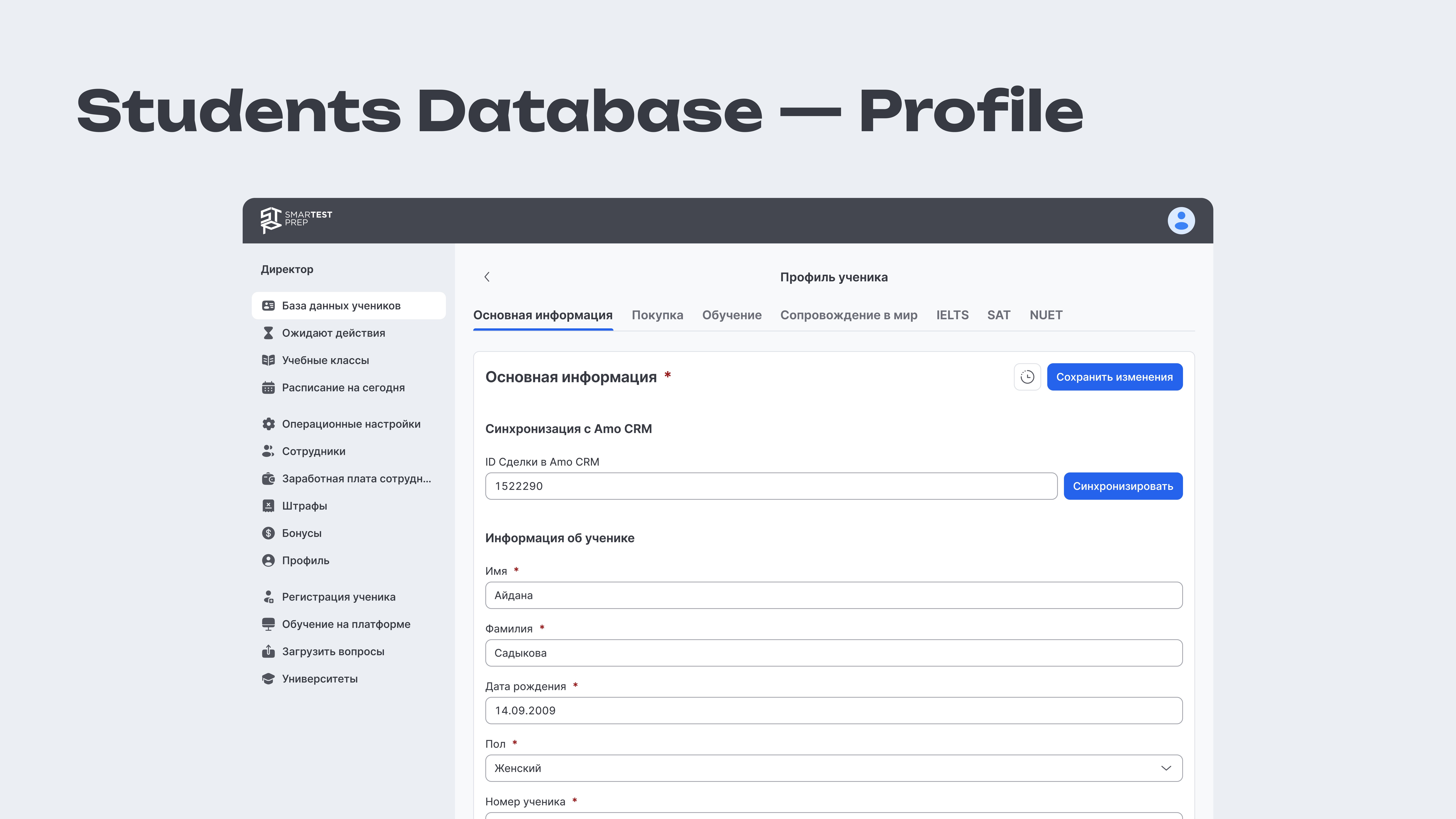
All student data in one place.
Keep track of every student by storing their personal details, learning goals, achievements, purchase history, and installment records in a single organized view.
Features
Oversee student learning journey on the platform.
From registration to course access and ongoing learning activity, track student progress and keep students and parents updated through detailed progress reports.
Progress